Showing posts with label book. Show all posts

Tuesday, July 8, 2014

Speaker for the Dead

So I haven't been painting, what have I been doing?  Reading.  Lots and lot of reading.  I cancelled my World of Warcraft subscription a while back and decided to get back to my real love; books.

So somewhere in the maelstrom of books that I've been churning through I read (re-read) Ender's Game just prior to the movie coming out.  As usual I forgot how awesome the book was, and I was very pleasantly surprised with the movie.

So, the book was good but I had never read the sequel, albeit it's so far removed from the first one it can stand alone no problemo.

I absolutely loved it.  It hit close to home on several counts.  There's an incredibly strong religious theme running throughout, there's an even stronger anthropological component, and of course it's still good ole science fiction.

The bugs, humanity's dire enemy, were wiped out to extinction.  The ramifications of this weren't fully felt until after the war; Humanity, Ender, wiped out an entire civilization.  After colonizing the stars, three thousand years later, humanity finally found their second sentient alien, the 'piggies'.  The Piggies are a primitive, forest-dwelling tribe that were found in the backwoods of a colonized backwater world.  The world being governed by Hispanic Catholic dictate that is now host to an outpost of xenologers (anthropologists who study aliens).

Those are the ingredients, the end result was a nice mixture of philosophy, tension, action, and some smarts to boot.  Is it a sequel to Ender's Game?  Not really, Ender's in it, there's mention of the 'buggers' but the story has moved on (and grown) so much they're not in the same boat really.  Plus, Orson Scott Card ain't no hack, the style of books one and two are completely different too.  If you loved the first book, and who didn't, you may not neccessarily love the second, though I enjoyed this Ender 'sequel' even more than the first.

Friday, October 26, 2012

Friday Rucht Hour: No Easy Day


So, this book has made the rounds in the media. I have to admit that I was just too curious about the entire event of the hunting Osama Bin Laden to not pick this up.

The book supposedly relates the story of the SEAL team that took out Osama Bin Laden on that fateful mission last year.

Like most books under a ghost author, the novel is a quick read. It offers a detailed look into the life of a Navy SEAL, their training, what it was like to go on mission in Afghanistan, and the psychological make up of those who serve in this elite cadre of soldiers. The latter half of the book is on the planning, training, and finally the execution of the raid on the Abbottabad compound.

The book is well-paced, puts you reasonably into the pants of someone serving in one of the more distinguished divisions of our military. Military enthusiasts and military historians will certainly enjoy it. Especially because it is such a quick read. Not nearly as dense as the latest books on John Adams or George Washington, the book is something that you could finish in a few days or a week. The book goes into the camaraderie the SEALs engage in - from the pranks they play on each other to the continual cracks they make.

The great controversy surrounding the book, of course, is that it supposedly revealed detailed information about the raid that went on in Pakistan. From my completely pedestrian perspective, it seems to me that the book is vague on the exact details of SEAL training. Also, many of the stories about their missions into Afghanistan are broad enough on the specifics that it doesn't seem to be too revealing to me.

However, I was indeed surprised at how much detail was given about how the raid was planned out. The text goes into step-by-step detail on how the strike was planned, how the chain of command operated, and so-on. Does it constitute a security breach? Does it put soldiers in harms way? It's hard to say and probably can be discussed by people far more qualified than me.

As for the raid itself - that event has been already well-documented and retold a thousand times. Nothing revealing in what I read there. It's interesting to me because the mission to get Osama Bin Laden raid reminds me of gunfights in the Old West in that regard - moments of violence whose briefest of moments have been documented with exacting detail.

So - would I recommend it to you guys? Yes, I would, actually. Gimme your thoughts and happy Friday, all!


Thursday, October 25, 2012

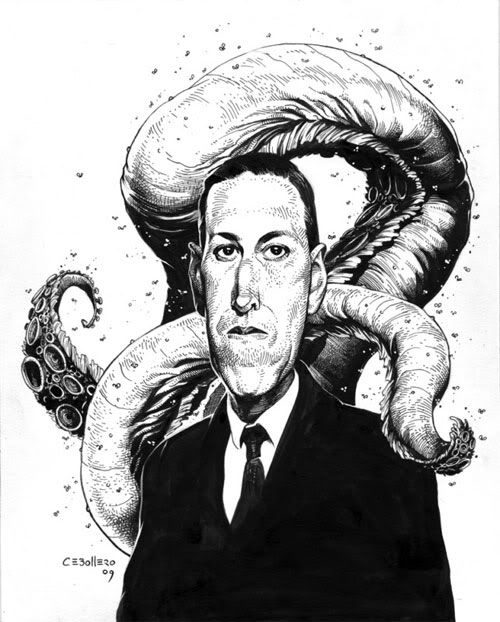
Thor's Day Hero: Howard Phillips Lovecraft


art copyright John Cebellero

Just saying his name, H.P. Lovecraft, evokes all kinds of immediate imagery. Here we are, about a week from Halloween, and I felt his induction into the Thor's Day Heroes was most timely. He's an author, alongside Edgar Allen Poe, some say one of our first proto-horror writers, but what he put down on paper was so much more.

I can't claim to have "love Lovecraft since high school" or some such, in fact it wasn't until the last couple of years that I really started reading his near hundred year-old work in earnest. Sure, it's horror, but it's also science fiction, and it's an imagination the likes we've not seen since. It's funny, sometimes reading one of his short stories you can easily predict where it is going and 'call it' pages before the big reveal, since it's been done so many times already. The catch is, he was the first one to do it.

It goes without saying his rich, otherworldly mythos that he crafted is just as stark and chilling today as it was alien back when he crafted it. It makes for good reading, makes for good gaming, it's just all around Elder goodness. Welcome aboard Howard!

Thursday, November 24, 2011

I'm Thankful For...


Elder Scrolls V: Skyrim!


The bulk of the work is done on the game-room remodel!


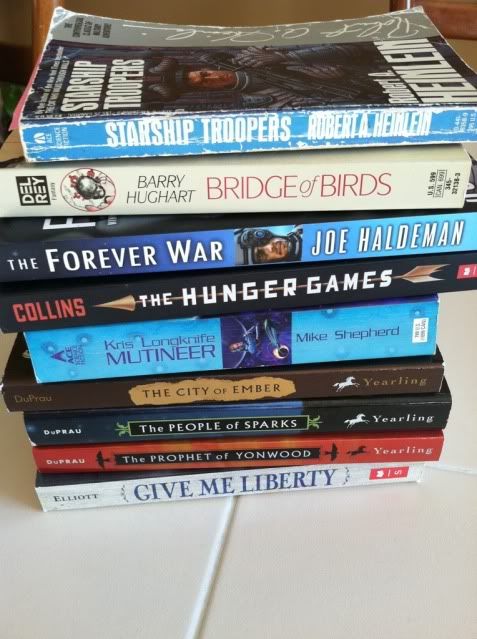
My big ole stack of paperbacks to read this holiday season!

Happy Thanksgiving everyone!

Thursday, October 27, 2011

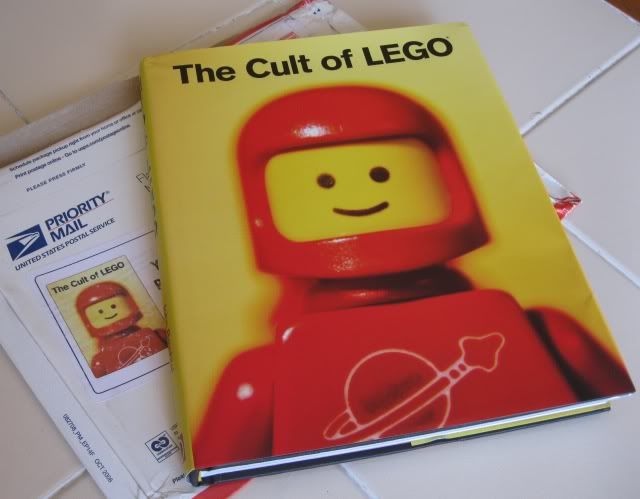
LEGO Thursday: The Cult Arrives


My advance copy of The Cult of LEGO came in the mail this week, yay! I'm keeping this teaser light, a proper review will coincide with the book's release but I can tell you this by thumbing through it already...The Cult of LEGO is an awesome book. Even if you just have a passing interest in LEGO it is definitely worth picking up.

Wednesday, October 5, 2011

Orphanage


Robert Buettner's Orphanage was exactly what I was looking for; it was a quick read that provided solid military sci-fi in a compact package. It had a very clever twist, taking place about forty years from now, humanity has reached a comfortable (albeit complacent) existence. Complicity doesn't allow for huge technological advances however and when Earth is bombed out of nowhere by an unfathomable foe, they realize they've got a lot of catching up to do.

Jason Wander is the protagonist and this first book details his story from before enlistment, through basic training, and finally off to war. The clever part is humanity has to rely on incredibly outdated technologies at first. Wander is given BDU's leftover from WWII for basic as an example. He trains on a Vietnam-era M16.

The source of the attack is discovered on one of Jupiter's moons, Ganymede. How the attackers got there and why they're attacking Earth is all in the details, so I won't spoil it here. Needless to say, the one criticism I have about the book is it seems an awful lot like the theatrical version of Starship Troopers. It has its obvious differences, but boil it all down and its basically a different take on the same plot. Mind you, I loved Starship Troopers, so I was fine with that.

Wander isn't a cookie-cutter, two-dimensional book hero either and the rest of the cast do their best to avoid stereotypes. The united Earth force of mixed nations is handled rather well, and the technology is suitably believable and "near future". At the same it doesn't beat you over the head with it either.

My used copy was a loaner but had a $2.50 pricetag on it, well worth picking up. There's a whole series that follows but the author wraps up this book with an epilogue well into the future that will satisfy any "what happened with this..." queries. I have a soft spot for this book as well because it closely resembles a memorable d20 Modern/Future campaign we played in which similar events took our heroes to one of Saturn's moons, Titan. If you like realistic military sci-fi, chances are you'll like Orphanage, I did.

Sunday, April 24, 2011

The Doom Star Series


This book review isn't really for just one book, but for a quadrilogy called the Doom Star series. Really, this review isn't for the actual books at all, but e-books. Honestly, what attracted me to pick up book #1, Star Soldier was the ninety nine cent price tag and after sampling the first chapter I thought it might be fun, quick-reading sci-fi.

In short these books aren't examples of masterpiece writing in the slightest. In fact it's almost shocking at the number of editing and typo errors within their digital pages. So bad it's to the point of distracting the reader away from the story itself. It's not just the grammatical errors though, the story bounces all over the place and the characters themselves kind of get lost in the shuffle along the way. So why bother if that's the case?

They are fun reads, plain and simple. From a gamer's perspective, which makes a big difference here, there's just a lot of 'cool' ideas and imagery that you could easily see translating into an RPG or maybe somewhere in miniature form on the tabletop.

The action will take you from Mercury to Jupiter and everywhere in between, all in what feels like a pretty well grounded hard-science setting. There's enough stuff along the way, and some very unique and memorable factions (no good or bad guys) that does break the bonds of hard science and just becomes good, ole sci-fi. By the time you finish the first book, you'll want to read the second one, and by the time that one's through you're committed. It's four separate novels, but they effortlessly flow right into one another.

The crux of the novels revolve around a main character, who like Forrest Gump, just happens to be everywhere at all the right (or wrong) times. This is good because things are quite hostile, stellar civil war is erupting all over the inner planets between the humans and the super-human soldiers once created to protect humanity. The scale and scope of the story is huge as well, as in a Dyson Sphere-sized manufacturing station orbiting Mercury huge.

It does keep you coming back for more, and like I said, I thoroughly enjoyed them. The author, Vaughn Heppner, has crafted a great sci-fi setting that holds a lot of promise. If book five ever comes out, yeah, I'd probably read it too. Check them out and enjoy:
The Doom Star Series
Book #1: Star Soldier
Book #2: BIO-Weapon
Book #3: Battle Pod
Book #4: Cyborg Assault

Tuesday, February 8, 2011

Kung-Fu Cavemen...from the Future!


If you hang out at all with the six to ten year old crowds you may have already heard of Captain Underpants. Well from the creative minds over at the Underpants dynasty comes this gem of a book, Ook and Gluk Kung-Fu Cavemen from the Future.

This is a fun read, plain and simple. Its title says it all really, and the adventures of Ook and Gluk (pronounced like 'book' and 'duck') are fairly epic. It's fairly epic too in the style of writing, it's hashed out as if drawn and written by a pair of ten year olds, all the way down to the atrocious misspelled words. Deeper still however is a sublime humor that us adults are going to sit back and say, "Hey, that's actually pretty good."

It's purely a graphic novel and has all kinds of wackiness to it, such as one-page chapters and "flip-o-rama" action sequences. Quite honestly, you could use any number of ideas in here for a light-hearted romp in RPG territory too, there's plenty of ideas lying within. So treat yourself to something completely different next time you sit down for a read.

Friday, January 21, 2011

Dauntless: The Lost Fleet Book 1

After having polished off a wonderful (albeit laborious) trilogy of books in the Song of Fire and Ice I felt I needed to go in a completely different direction for my next books.

Book one of Jack Campbell's Lost Fleet series proved to be just that. I find that by the time I roll around to reviewing books, someone out there has already done so, and more than likely bested me at it. So I try to just give my own impressions and leave the heavy-duty reviewing to the talking heads.

The official blurb: "The Alliance has been fighting the Syndic for a century-and losing badly. Now its fleet is crippled and stranded in enemy territory. Their only hope is Captain John "Black Jack" Geary, a man who's emerged from a century-long hibernation to find he has been heroically idealized beyond belief. Now, he must live up to his own legend."

The Lost Fleet was a great read, I picked it wanting to get into the familiar genre of military naval tradition turned slightly on its ear and put in deep space. By its very nature, military sci-fi was guaranteed as well. Plus, it turned out to be a surprisingly quick-read too, three sitting in total, so it was a page turner to boot.

Space combat and fleet tactics rule the action, and Campbell takes great care to provide enough detail to make it seem very plausible, while handling things in a non-PHD needed atmosphere. Things you don't really consider in space play big factors, like how fleets moving at appreciable fractions of light-speed have to compensate for communication time-lag as well as targetting and obtaining visuals. Actually, obtaining visuals is next to impossible; by the time you see an enemy fleet enter the system you happen to be in, the images are already hours old.

The character development was pretty flat, the only one you really get to know is the main character, "Black Jack Geary" himself. Mind you, he's almost enough to pull off the whole book on his own, but some other interesting characters would've been nice as well.

There are some pretty great space battles, like I mentioned, the details were excellent and the action wasn't muddled in physics. Geary's monumental task ahead of him is to get his beleaguered and undisciplined fleet back to home space, while being dogged the whole way by the bad guys. I'm assuming this task of his takes about six novels to complete. I also assume by the end of the sixth novel you've experienced enough near-light speed fleet battles to last three lifetimes. That's why I'm stopping here.

Dauntless was a quick read and a lot of fun. It gives you a naval-eyed view of space combat, and military structure while pulling off a good deal of depth, thought, and complexity without being inaccessible. It is what is it is though. This guy leading his broken fleet home, trying to win their trust and respect along the way. He wrestles with his Rip Van Winkle-ness too, trying to relate to what the fleet he knew a hundred years ago has become today.

You'll like it at least as much as I did. It'll get you wanting to play Battlefleet Gothic (free!), or in my case, Firestorm Armada at the very least. You may stick around for the rest of Black Jack's valor and fleet antics as well. I think I got a good enough glimpse however.

Thursday, January 13, 2011

A Song of Fire and Ice


You really have been under a rock if you haven't heard someone around you talking about George RR Martin's Song of Fire and Ice series. Originally supposed to be a trilogy, its banks have now swollen to include a fourth book, with apparently at least three more on the way. I should also point out that these books are incredibly slow to come out. For this post, and it's been a while since I reviewed a book, I'll review:

A Game of Thrones
A Clash of Kings
A Storm of Swords

So why review a series that's incomplete? Mainly because the first three books you see here form a brilliant trilogy and although you're left wanting more, you can certainly be satisfied with what is contained herein. Also, these aren't your avergae-sized paperbacks, the three volumes are pushing two thousand pages in all, so you've got your work cut out for you. In a way there is a very natural stopping point after the third books as is.

It's almost silly to try and review each book on its own merit, they truly form an unbroken tale from the first page of book one to the last page of book three. Martin's crafted a world that is rich in detail and believable to boot. It's jam-packed with characters that you really get to know, and his character development is methodical and paced across the span of the trilogy. There's always something new lying in wait for them, and it just keeps getting better (or worse) as the character's lives move on.

It's an interesting style in which the books are written too. There are no chapter numbers, each chapter is simply titled with the name of the character that is prominent in that chapter. Also, events aren't entirely chronological either. Some events, possibly hundreds of pages apart, are actually taking place simultaneously depending on the situation.

You will definitely start to collect your favorite characters, and you will cheer them on, and then regret that later when something terrible befalls them, or they begin to become something you never saw coming. There are no good guys or bad guys, in the dead of winter there are only shades of gray. Heh, I just made that up.

Is it fantasy? You bet, but just like you hear the term "hard" sci-fi sometimes, I would say this is "hard" fantasy, there's no floating cities, white wizards, or even pointy-eared folk fighting greenskins, but it is fantasy, and once those gears start kicking in you'll be pleasantly surprised. I can't stress enough what a great story unfolds in these three books, it will be worth your while to read them if you haven't already. For me, I'm going to hold off reading the fourth book until at least the fifth book comes out, that way I can read them together.

If you've got a e-book reader, these are just five bucks a pop as well, which is an incredibly good value. I have a feeling that the HBO show based on this series that is due out in April is going to be a pretty big deal, so why not jump ahead of the curve so you can be all smug and talk about how you were reading these books before the tv show, haha.

Thursday, November 18, 2010

Casemate Publishers

Just when you thought all of my posts on Fall-In! were over, I sneak one more upon you! This is one makes me pretty happy to share too, and as the title suggests it involves a company called Casemate Publishers.

Casemate ran a booth in that massive dealer's room, and it was a good sized one to boot. Their specialty lies in military books, history books, and the like, covering all time periods where man fought man. They were having a prize drawing and not a lot of people were signing up from what I saw. Actually I should say from what Andy saw, since for years to come it will invariably be him that (rightfully so) takes credit for most of this. Andy won one of the daily prizes which was a sweet $50 dollar certificate to be used at their website. With so many options, I just know he's going to get a headache trying to decide. Well I signed up for the drawing as well, but unlike Andy I did not win any of the daily drawings. No, I instead won the $350 dollar grand prize!

It was no secret I went to Fall-In! on a budget, and had to restrain myself from going loco in the dealer's room, not to mention I ate sandwiches out of a cooler the whole weekend, so this little bit of gamer-karma-come-back-atcha was certainly a welcome surprise. I placed my order this week, so when that big box of shiny new books gets here, expect a follow up post!


Well I'm a gamer first and foremost, so I went there right off the bat, opting for Foundry's "Rules With No Name", and Warlord's new Black Powder rules. The former is free on the web, but the published copy has been held in fairly high regard. Cowboys are something we've certainly had fun with many time sin the past too, plus it fills quite the gaming void on my bookshelf. Black Powder was really a grab for the spectacle of it and who knows, maybe one day it will give up its intoxicating call to a humble weekend painter like myself. In all seriousness I've heard nothing but good things about it and it really does sound like they were written the way rules should've been written; clear, solid, and open to allow the spirit of the game supersede the letter of the rule. While I was at it I picked Andy up a copy as well, you know, since he took me to my first dance and all.


You may be thinking that I just started clicking away like mad adding books I've never heard of to my online Casemate shopping cart. Well, that's only partially true! After my cart was overstuffed around five hundred bucks I went in and began weeding through it. I used several internet sources to check the books not voted off the island for reviews and what-not. The two here are similar in nature in that they deal with specific commanders during specific time periods. By going into biographical detail of the person, you get greater insight to the wars fought under their watchful eye, and to the specific state of the world as well.


When I talk of my Anthropology degree it's usually in reference to what I focused on as my specialty, which is prehistoric man and human origins. That wasn't all I took however, and the archaeology portion of my degree was centered around the time of the American War of Independence, so I gravitated to both of these books. Despite their very similar titles, from what I could pick up, the two books complement one another rather well with little to no overlap. I'm not known for my historical gaming sense, but these may be the push I need as well.


Britain, both old and new round out my shopping spree. My Irish Guards army is ambitious in scope, just slow to get going (all my fault of course). One thing I do know is that you can get lost with all of the tales that unfolded during WWII. For me I've set my eye on Operation Market Garden. For that, the Arnhem 1944 book looks to fit the bill.

Monday, July 26, 2010

Me and Artie


Scrolling through my subscribed blogs the other evening I ran across a nice Lovecraftian mythos collage on the diceRolla's blog. Oh, and as a hint to any fledgling bloggers out there, it's the pictures that grab me first and foremost, not titles or text blocks!

Well I'm glad it did grab me 'cause what Papa JJ posted was a literary analyzing site called "I Write Like". Basically you put in your pasted text and it "analyzes" your work and comes up with a close match to which famous author your style most closely resembles. The only two qualitative factors it mentions are "writing style" and "word choice". Apparently this thing has gone viral all over the place and it's little more than a lark, but it's still fun. Fun in the same vain as like, "what's your pirate name?", or "which Flash Gordon character are you?". I made up that last one, but it's one I'd like to see none the less!

Anyway, all I did was take my text from my post on the recent space station skirmish battle we had, popped it in the ole analyzer, and voila, Arthur C. Clarke. Whoa, he's like, all good and stuff when it comes to sci-fi writing! Am I the next Arthur C. Clarke? No, but it's still a fun diversion nonetheless. I can't boast anything like ole Artie, it's still nice to think about. Looking at the photo, that's basically me in forty years anyway. Enjoy!

I write like
Arthur C. Clarke

I Write Like by Mémoires, Mac journal software. Analyze your writing!

Sunday, April 4, 2010

Novel: Death's Head, Maximum Offense


Death's Head: Maximum Offense (2009)

Hot on the heels of finishing up the first Death's Head book by David Gunn, I went out and quickly picked up the sequel. It was actually the first time I lamented not having a Kindle, or similar book reading device; I could've just downloaded the sequel from the comfort of my own home and not skipped a beat. I guess I was eager for more.

The sequel picks up within a few months of the beginning in the first book, and continues the adventures of Sven and his team, the Aux. The rich world I continue to appreciate grows in scope and detail, but isn't needlessly bogged down with too many details. In fact, the narrative style continues with not really explaining every finite detail you come across. What is, just is, and you get to focus more on the characters and the story, and less on the technical aspects. It's neat to do it like this because in a way, you don't really know more about the surroundings and physics behind the universe than the actual characters do.

Sven continues to be the ultimate soldier with the ultimate arsenal of weapons, equipment, and brawn, and the writing style continues to be explicit, straight-forward, and unabashedly raw. The "heroes" are sent on a new mission that only three people know about, and given a wet-behind-the-ears Colonel who is not combat tested to "lead" them. It's only after hitting dirtside on an artificial ringworld that the team realizes they don't know the full details, and their mission was a cover for another mission, that happens to also be a cover for one last mission. In what is becoming classic form for Sven and his team, they plow straight ahead, boots crunching, necks snapping, and his intelligent gun smart-mouthing along the way.

There is a lot going on in this book, moreso depth-wise than the first one, and for that I can't spoil much without giving away plot twists and the like. The big picture gets even bigger, more of the universe is unveiled, and more of the three factions (the humans, the enlightened, and the uplifted free) are given light in their operations and interactions.Suffice it to say, if you enjoyed the first novel, you'll like this one even more, I did.

Sunday, March 28, 2010

Novel: Death's Head


Death's Head by David Gunn, 2008

Looking back, it's been a while since I've reviewed any books. I know the pulp Conan books weren't the only ones I've read since November, but nothing else comes to mind. Then there's Death's Head, something I literally picked up on a whim at the used bookstore for $3 bucks. Now it's not the "best military sci-fi" I've ever read, but it was pretty good.

The book is novel-sized but split into two distinct parts. The first half of the book sets up the main character, Sven, who has a host of traits that put him head-and-shoulders above your average soldier. It gets into his background, who he is, where he came from, and ultimately how he comes to be in the present; and that's in the service of the Death's Head, an elite branch of the military under the OctoV empire. The second part of the book jumps right into the action, as Sven hits dirtside on an enemy planet against overwhelming odds.

The technology is pretty widespread, from basic slug throwers to dimensional shifting and everything in between. There's actually a lot of cool things that the main character "uses" that I hesitate spoiling here. One thing I will let slip is his sarcastic, intelligent gun. The sights, sounds, and smells Gunn portrays cover to cover are vivid, and crudely raw. There's a prevalent sexual element (as common with most ground-pounders and loose women) throughout, and it gets fairly explicit. Also, there's a certain olfactory ambiance that's equally crude, and mostly revolves around feces. Now I say "crude", not in the literary sense, but just in the unabashed truthfulness of it, nothing is sugar-coated, or even moderately softened.

The action is good, but this isn't an action book and many portions are without. This is a good thing though because real character development takes place and something resembling a story emerges; before you know it, you're really getting into it. By the time you've got less than a quarter of the book to go, you're already eager for the sequel.

Saturday, November 28, 2009

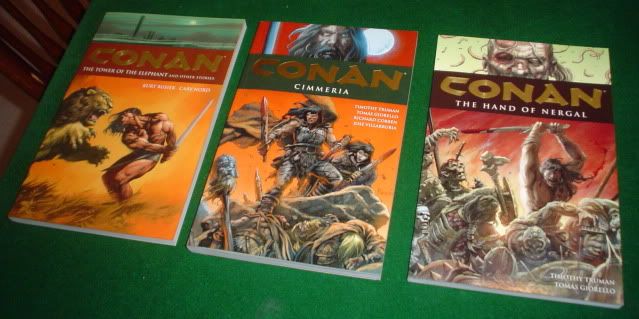
On a Conan Kick...


I've been on a Conan kick as of late, with three different mediums under my belt; novels, movies, and graphic novels. You know what, after mixing all three together, the blend that came out was just some good ole fashioned, unabashed, sword and sorcery. Other than a brief read here and there in high school, I never dedicated much time to the Robert E. Howard novels, or the related pastiches. Being a comic fan, I've thumbed a few dozen issues of the old Marvel run, but nothing great. Then of course you've got the movies.

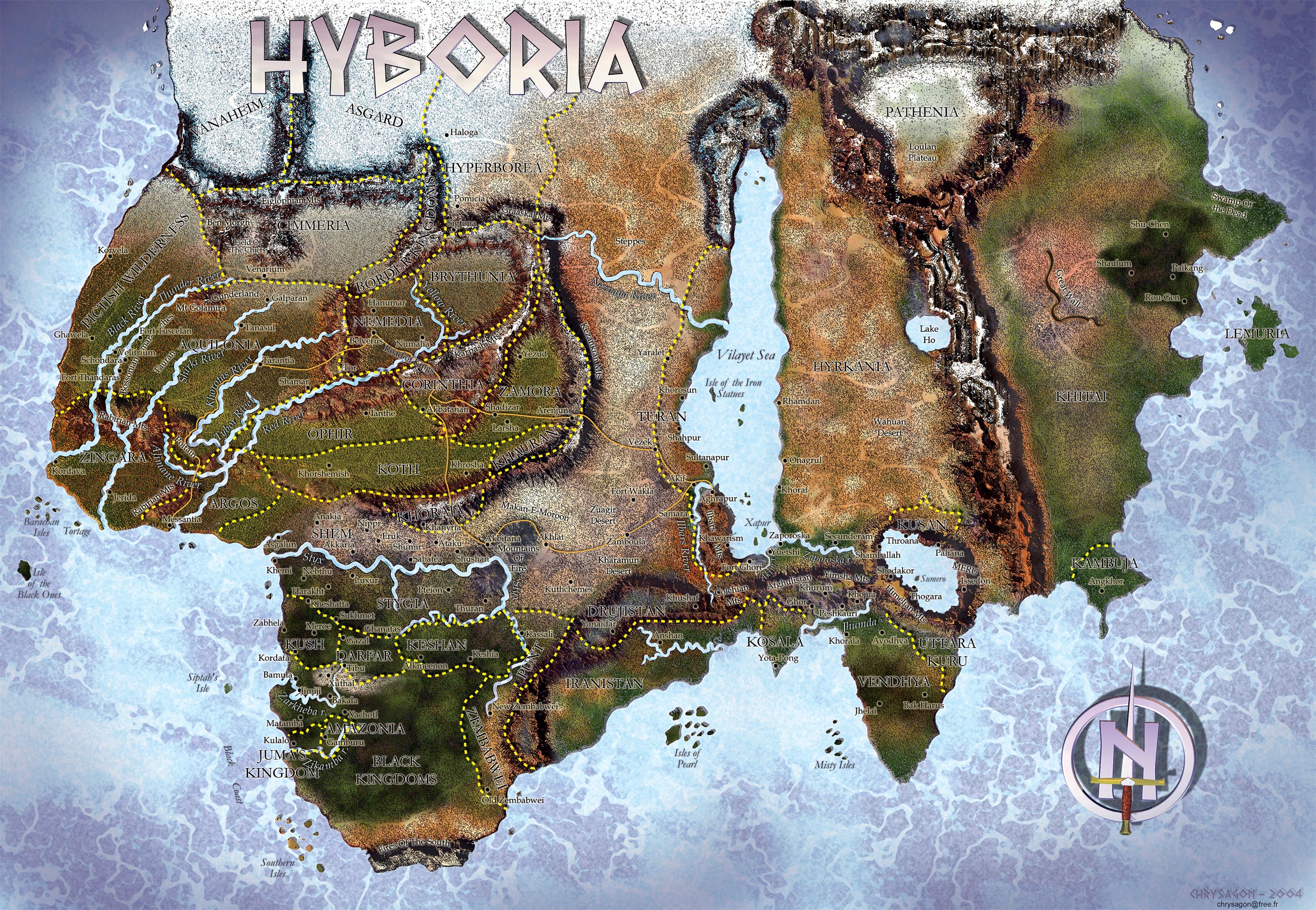
You can pick apart facets of this storied franchise and whittle it down to nothing, but why do that? Conan's pushing eighty years old now and it all keeps getting better and better. Reading graphic novels and books, with some movies (and even an Xbox demo of the same name) mixed in, a certain indelible image lingers in your mind and a certain ambiance permeates throughout, and the world of Hyboria is a rich one indeed.


There were the Marvel comics of old, those are the ones I had, then Dark Horse Comics got a hold of the licensing fairly recently. What they've done with the name is glorify in all the right ways. Industry greats all grace the pages of Conan's four-color history, and not only has Dark Horse put together some amazing trade paperbacks of new material, they've also collected all the old appearances of Conan in easy to read formats.

The three trade paperbacks I read weren't in chronological order, but for a pulp adventure tale such as Conan, you don't need to "stay tuned" for every episode to get the gist of his adventures. The quality of these comics far surpasses anything I've seen lately, and the artwork and writing go hand in hand to make some memorable tales.


Sure, you see Arnold all oiled up and holding a bastard sword and it's hard to stifle a groan. Frankly however, the first Conan movie is pretty freaking cool. I highly recommend to anyone who doesn't own it (or maybe those who do) the director's cut, it makes a good movie even better (and it's just ten bucks!). After reading a couple of the novels I popped this in one day, and although it's greatly condensed, John Milius captured the mythos of Conan as good as anyone could have at the time then, or now.

So I'm nearing the end of my Conan run, I've got six novels (the old Ace Paperback series), two movies, and a trio of graphic novels under my belt. I gotta tell you, I am a very happy camper overall. I had no idea of the depth, scope, and sheer kick assedness of Conan and the lands of Hyboria truly were. I had no idea Howard and Lovecraft corresponded frequently and it shows in Howard's writing as many of Conan's foes touched upon the Lovecraftian mythos itself. Hyboria is just too good to pass up, so ye this, it is more than a governor's former film career, it is an amazing realm of high adventure. I'm tempted to break out the ole notebook and do some outlines for a possible campaign set in Hyboria...

Friday, September 25, 2009

The Pirate King


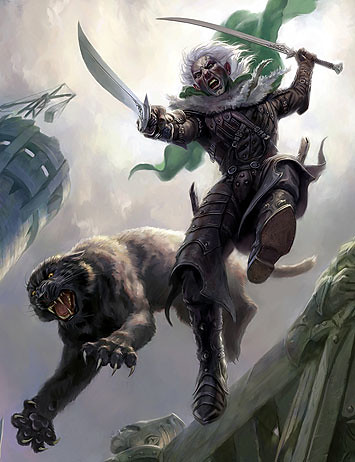
Lockwood's cover for Salvatore's latest Drizzt book

Following up the first book of the Transitions trilogy is the latest "king" titled installment, the Pirate King. Drizzt and company are back at it again, romping to and from, scimitars flashing away. Sounds familiar, doesn't it? I don't want to disparage the book, it was actually pretty good, but it is very familiar territory, only the foes change.

The Pirate King felt like it was simplified somewhat, and it also felt it had set out with a very real goal to tie up certain loose ends that had been cropping up over the last few books. It does well, to Salvatore's credit, and by the end of the book, all those little nagging details you've been wondering about for a while are cleaned up.

I was surprised by the amount of time the book lets go by, almost a year, and I was even more surprised by the amount of glossed over space in many of the scenes. Entire books could've been written about some of the side quests mentioned half-heartedly and quickly moved past. For one, and this is no spoiler, Cattie-Brie continues her magical training with the archmage of Silverymoon. A journey to take them "halfway around the world" learning along the way. Literally that was all that's said of it, see ya later Cattie-Brie.

In the beginning of the book, you see most of the hero characters, but soon after the story becomes all about two, and just two; Drizzt and the halfling Regis. This was quite refreshing because there weren't too many characters taking up screen time, and you get a lot more insight and development to the halfling that usual, since he's always dwarfed by the other larger-than-life characters he keeps company with.

The story really only involves the duo because they happen to wander into it, they are heroes, but not the main characters. That role falls on the stalwart Captain Deudormont, who has made appearances in many of the past books. It is a tale of the Captain leading the forces of good to retake the City of Sails, Luskan, from corrupt forces that have exploited their positions of power for too long. The primary adversaries are the wizards belonging to the Arcane Brotherhood led by their Lich master, but there is also complex intrigue as the five pirate high captains who control parts of the city also become involved, manipulating the events along the way. Drizzt and Regis assist Deudormont, but the book really is about him.

I looked up Luskan in my 4e Forgotten Realms Player's Guide, and wow, it's quite the cesspit. I think the book literally said it was "the most miserable place in all of FÃ¥erun". Undead roam the streets, acid rain unleashes mutants on the populace from a floating island. Crime and vice, murder and extortion are the way of life in the streets. A far cry from what Deudormont is trying to achieve. Salvatore does a good job in setting all of this up, these "transitions" from old DnD3.5, to a hundred years later with 4e. You can see the cracks appear, and know ahead of time (thanks to the sourcebook) that Luskan is swirling the drain.

The book isn't out of place, but it feels like it rushed things a tad to squeeze them all in succinctly into a rapidly degrading timeline. 4e's been out for a while, the Spell Plague has ravaged the Realms for sometime, and it feels like these books need to hurry up a catch up with the current fluff. It can't be overly rushed, but some semblance of pace needs to be kept. I feel like that balance isn't quite obtained in this one.

Having said all that, it's not a bad read. There are some very surprising revelations near the end, and the beginning of the books takes care to bring the reader to speed on what's been going on during the downtime. In the middle of the book, Regis and Drizzt take off to attempt to find an old friend lost to the group as well as pay a visit to the place where they first met. I was not a fan of the glaring gaps in the action, and events seemed to be handled too quickly for my taste. I was pleased with all of the characters, both old and new, and their interactions with the surroundings. Drizzt's typical, heavy-handed philosophizing is present, but you get used to it after so many books I guess. Well, there you have it, enjoy!
Friday, September 11, 2009

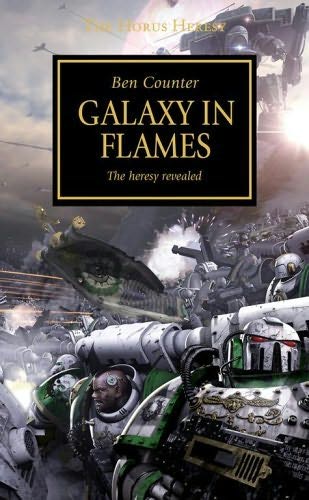
Galaxy in Flames


Ben Counter's contribution to the Horus Heresy

I absolutely devoured the third book in Black Library's Horus Heresy series. After False Gods, I was slightly put off, but since I bought the first three books at the same time, I plodded along with book three. If you read my last review, I never said 'Gods' was "bad", but compared to this installment it pales considerably. I'm not familiar with the works of Ben Counter, but I've got to hand it to him, he does the world of the Astartes justice.

As I mentioned in the comments sections of book two's review, a lot of the loose ends I lamented in book two not only got wrapped up in this third one, but they weren't handled just for the sake of efficiency, but given some development and depth on their own. The full betrayal of the Warmaster Horus comes to a chilling fruition in this book and the events take place around a single event and the subsequent, drawn-out engagement in its aftermath. It is a well described tale, and each legion (chapter) involved is given the very distinct personality they deserve. The action is handled very well, and from a military sci-fi standpoint, moves along at a good clip. It mixes it up well from large scale actions, to one-on-one combat. In the initial assault on the technologically advanced world of Istvaan III, the descriptions of the people, cities, weapons, and armor was both interesting and vivid.

By the third book you'll probably become invested in most of the 'major' players and a handful of minor ones too. Many of the civilians have found new inner strengths and find it within themselves to stand up for their beliefs, no matter the sacrifice. The Astartes characters we have watched stand firm against a collapsing world around them continue to hold resolute as matters go from bad to much, much worse. The birth of the Imperial Cult, and the deification of the God Emperor of Mankind takes hold as a spark of light in the ever-growing darkness. Many brave souls meet their greatest challenges, and microcosms of Horus' grand betrayal are echoed throughout many of the individual storylines woven throughout.

I barely put this book down once I started it, it really grabs hold of you and propels you at a breakneck pace 'til the bitter end. It's a roller coaster of emotions, for lack of a better word, in and out as heroes triumph, only to face bigger challenges. Hope still flourishes, and the setup is laid out nicely leading to the next anticipated novel, Flight of the Eisenstein.

Monday, September 7, 2009

False Gods


I just finished Graham McNeill's False Gods, the second book in Black Library's Horus Heresy series. I read the beefy Ravenor in between books one and two of the series, but it didn't take too long to get caught up to speed with the characters and events. The time between the two novels is fairly short, and the overall storyline continues along without too many hiccups. There is a second author at the helm, with some notable style changes.

The book seemed 'choppy' for lack of a better word. Some of the choppiness was to set a dramatic tone, back and forth between scenes, which was fine. That's kind of expected, but other parts of the book weren't intentional, and came up a tad 'jerky'. There was a list of characters in the beginning of the book, but it seemed a bit unnecessary as they weren't all fully explored. An in-depth look of the massive Imperial Titans was hinted at early in the book, but sadly never followed up on other than a few cameo battle appearances.

Many situations would arise, and I expected the characters to deal with them at one point or another, but as my page count got less and less, I realized that they would just be loose ends. Some did work themselves out, though it seemed to take a while. By largest complaint about the book was exactly how fast the fall of Horus took place. We all know Horus goes corrupt and fights Emperor of Mankind; but to take such a goodly figure and turn him wholly corrupt should take more than half a novel. His fall should've taken place across several novels, there's no reason to rush something this epic otherwise.

False Gods didn't do a whole lot to knock my socks off if you can't tell, but it did have it's good points. My favorite characters of the first book, captain of the tenth company Garviel Loken, and his associated cronies (Torgaddon, Vipus...) continues to get better and I am eager to see how his character further evolves in the third book. Where actions in the book I thought could've been handled better, many of them were handled very well, and the book kept a solid pace going from cover to cover.

When preparing for a long haul like the Heresy series, you're going to encounter some amazing works and some not so much, that's just the nature of things. Don't let my somewhat mixed review throw you off, False Gods is still a solid chapter in the overall picture.

Wednesday, August 19, 2009

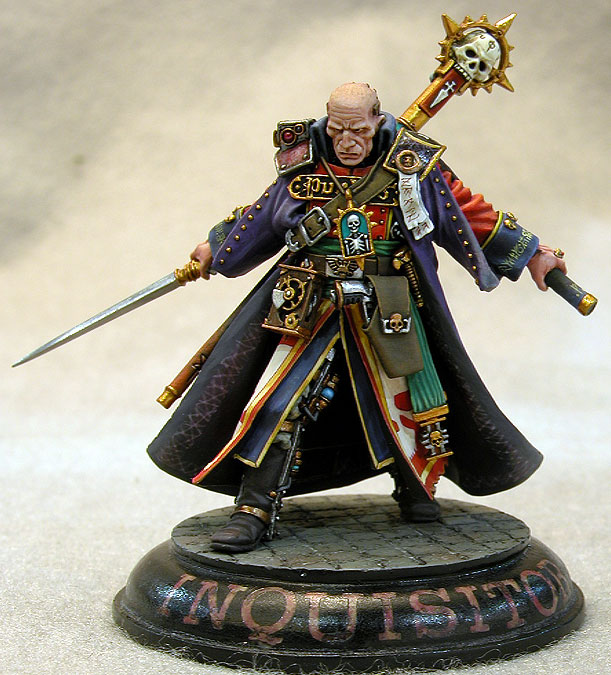
The Ravenor Omnibus


Dan Abnett's Ravenor Trilogy

I devoured through this omnibus, 900 pages, like a rabid warp daemon in just barely a week. Following up the excellent Eisenhorn omnibus not that long ago, I plopped down for this one as soon as I heard it was coming out confident it'd also be a good read. Also for a mere ten bucks (or so), it's an even better deal than most.

I'm going to not draw too many comparisons between this trilogy and Eisenhorn. With all of their similarities, very similar, they read very differently. Eisenhorn focused mainly on the man himself, his rise and fall as an Inquisitor. Now about Ravenor, yes it is largely about Gideon Ravenor, but moreso about his acolytes and retinue.

The time frame across the trilogy at its core is just about a year at most, but a good six months of that time is spent in transit, or recuperating, or the like. There is a definite plot that weaves through each novel, and instead of each novel reading on its own, they weave together nicely for a much larger tale. The acolytes are great, and Abnett really delves into each and every one of them. At first, I thought it would suffer from 'Lost' syndrome, and have way too many main characters, but he handled them well and the number was just right.

As far as a primer goes for a 40k newbie goes getting into Dark Heresy, I would recommend this trilogy over Eisenhorn actually. The chemistry and skills of the team work together in harmony to infiltrate criminal underworlds, hack systems, fight heretics, and basically kick arse in the name of the Emperor. Through these very skilled, but also much human characters, you feel closer to the action, and the danger threat is much more real. The big draw to the trilogy for me was also how almost nothing ever went according to plan. Seriously, I wouldn't call Ravenor and his crew "bumbling", but man, every time they had a plan, it got screwed up...bad. This usually meant someone getting the jump on them in a very bad way. Speaking of which, Abnett doesn't pull any punches with his characters. His portrayal of life in the Inquisition is hard and fast, and often it is very gritty and brutal.

If you read Eisenhorn, you've probably already read these, if not, it's no big deal, Eisenhorn is not a prerequisite. The action is well written, and there is a great cop-drama vibe throughout with a hefty helping of dark occult activity. You'll be invested in the myriad of characters, and though I've understated him somewhat, the namesake character, Ravenor, is pretty darn cool. It's a good read, and even though it's as thick as a phonebook, it's a surprisingly fast read to boot. A couple of short stories bookend the middle book, and each one really added to the overall story. One was an origin story of one Ravenor's trusted acolytes, and the other one takes place chronologically between the first and second book and has a surprising guest star in it. It's a great journey furthering the world of the Inquisitor and their fight against the ruinous powers, I highly recommend it for casual and hardcore fans alike.

Wednesday, May 20, 2009

Singularity Sky

The novel is set far in the future after a forced diaspora of humans across the universe by an artificial intelligence run amok, the Eschaton. Unfortunately, I have absolutely no idea why the AI is doing what it does, or anything else about it - other than its prime goal is to keep humans from messing around with faster than light travel (FTL) and the possibilities of time travel it implies. That point is driven home Ad nauseum. The Eschaton doesn't want anybody going back in time and changing the conditions that brought it into existence. Other than that, the Eschaton is just background filler at best.

The bulk of the novel is about a planetary system, the New Republic, run by a militaristic authoritarian regime that prohibits high technology and is intentionally isolated from the rest of the humanity. A Marxist (yes, Marxist!) revolutionary cadre has sprung up on one of it's backwater colony planets - which explodes unpredictably when a mysterious starship calling itself the Festival arrives offering the inhabitants anything they want in exchange for information (stories, theories, what have you). They suddenly find themselves with all the material and technological goods they could have ever wanted, with some unintended consequences. Sound boring yet? Yes, it was.

While his wordplay, setting, and concepts are nothing short of breath-taking his characters and plot development are nothing short of yawn inducing. I trudged through the novel as best as I could, and it took considerable effort to finish it. It was lauded with much praise, and I can certainly see why a novel such as this would be an instant hit with particular readers, but Stross' brand of "hard" sci-fi just wasn't my cup of tea.